

Jensen Huang’s Nvidia Exit: The Scandal, CEO Resignation and What It Means for AI Investors
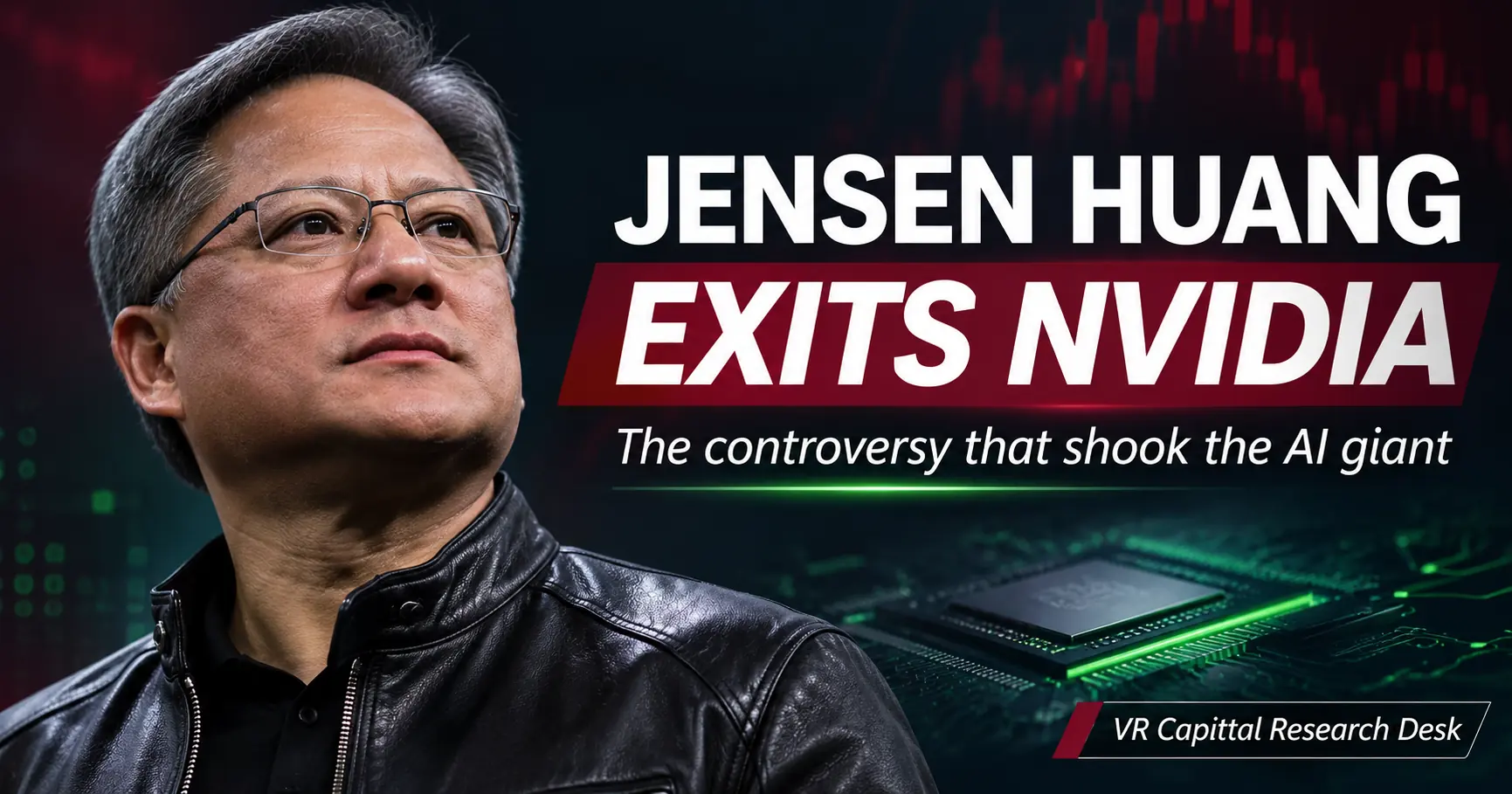
Jensen Huang’s Nvidia Exit: The Scandal, CEO Resignation and What It Means for AI Investors
From an extraordinary leadership crisis to record-breaking earnings: separating confirmed developments from allegations.

One of the defining figures of the artificial intelligence boom has left the company he helped build. On 12 November 2026, Nvidia announced that co-founder Jensen Huang had resigned as president, CEO and board member. His departure followed revelations about extramarital relationships and questions concerning one reported relationship with a businesswoman alleged in media reports to have intelligence connections.
The important distinction: Huang’s exit is confirmed; serious allegations surrounding foreign intelligence remain allegations. Neither a personal relationship nor an inquiry, by itself, proves espionage or corporate misconduct.
- 12 November: Nvidia publicly confirms Huang’s immediate resignation.
- Interim leader: CFO Colette Kress takes over as interim CEO.
- 17 November: Nvidia’s board says it does not intend to reinstate Huang.
- Business performance: Nvidia announces $115.8 billion of quarterly revenue, 103% higher year-on-year.
- Investor question: Can Nvidia preserve execution and investor confidence without its long-serving founder-CEO?
How did the controversy begin?
Reporting about Huang’s association with Alice Huang, a former executive at Singapore-based Megaspeed International, had been attracting scrutiny. In November 2026, fresh reporting raised allegations that she had ties to Chinese intelligence. These claims have prompted national-security questions because advanced AI chips and the international AI supply chain are strategically sensitive.
Huang publicly acknowledged marital infidelity on 8 November. Subsequent coverage also described relationships involving Nvidia employees, bringing corporate governance and workplace conduct into the conversation. It would be incorrect to treat the reported intelligence allegations as proven facts or assume that sensitive information was transferred.
Key events: a timeline
Why the situation matters beyond one CEO
Jensen Huang co-founded Nvidia in 1993 and became the company’s most visible spokesperson as its GPUs emerged as essential infrastructure for modern artificial intelligence. His influence extended beyond product launches to relationships with cloud providers, governments, developers and investors.
That made the scandal consequential on several levels: the effectiveness of board oversight, the handling of potential conflicts of interest, succession planning and uncertainty around strategically sensitive business relationships. The company has maintained that its leadership team can continue operations and its product roadmap without interruption.

What has Nvidia said officially?
In its 12 November statement, the company confirmed the resignation, appointed Colette Kress as interim CEO and announced a search covering internal and external candidates. Board chair Harvey C. Jones expressed confidence that Nvidia’s operations, commitments and technology roadmap could continue. The initial corporate announcement did not substantiate any espionage claim.
During the 17 November earnings call, Jones said the board had accepted Huang’s departure following disclosed personal conduct inconsistent with company standards and did not intend to reinstate him. That decision sharpened the distinction between Huang’s legacy as founder and his future role in management.
Strong financial results, but shaken investor confidence
Nvidia’s third-quarter fiscal 2027 earnings, released on 17 November, illustrated why the investment debate is complex. Operational momentum remained formidable even as the company faced an unprecedented leadership transition.
These figures capture a tension: the business can be growing rapidly while investors reduce the valuation they are willing to pay. Reuters reported that the shares closed 2.9% lower on 18 November, with the decline from the early-October peak reaching approximately 36%. That broader decline cannot be attributed solely to the resignation: AI valuations, infrastructure spending, China-related uncertainty and regulation also contributed to sentiment.
What should investors watch next?
- Permanent CEO: The eventual appointment and credibility of the successor.
- Independent investigation: Any confirmed findings, with proper separation between evidence and speculation.
- Regulatory scrutiny: Disclosures concerning corporate governance and export-control practices.
- Execution: Deliveries, hyperscaler demand, product launches and customer retention.
- Valuation: Whether earnings growth is sufficient to justify the market’s expectations after volatility.
VR Capittal perspective: focus on fundamentals and risk
For investors, the lesson is not that every high-profile controversy warrants an immediate buy or sell decision. It is that even an outstanding company faces key-person, governance, regulatory and valuation risks. Portfolio concentration in a single AI company or theme can magnify the impact of unexpected events.
A balanced assessment should distinguish the facts of the leadership transition from uncertain allegations, monitor the board’s next steps, evaluate financial performance and apply sensible portfolio diversification. Short-term price volatility alone does not establish long-term value.
Looking beyond the headlines?
VR Capittal helps investors think through portfolio concentration, diversification, asset allocation and long-term investment planning.
Sources and further reading
- Nvidia: official CEO-transition announcement (12 November 2026)
- Nvidia: Q3 FY2027 financial results (17 November 2026)
- Reuters: background and controversy timeline
- TechCrunch: board’s position on reinstatement
- Reuters: post-earnings market reaction (18 November 2026)
Disclaimer: This content is provided for general information and investor education only, not as a recommendation to buy or sell any security. Market data are date-specific. All investments involve risk. VR Capittal – Smart Financial Solutions.
Want to discuss your own situation?
Talk to the VR Capittal team for a free consultation.
Chat on WhatsApp Contact Us