

The Chinese AI Market Crash: What Happened and What It Means
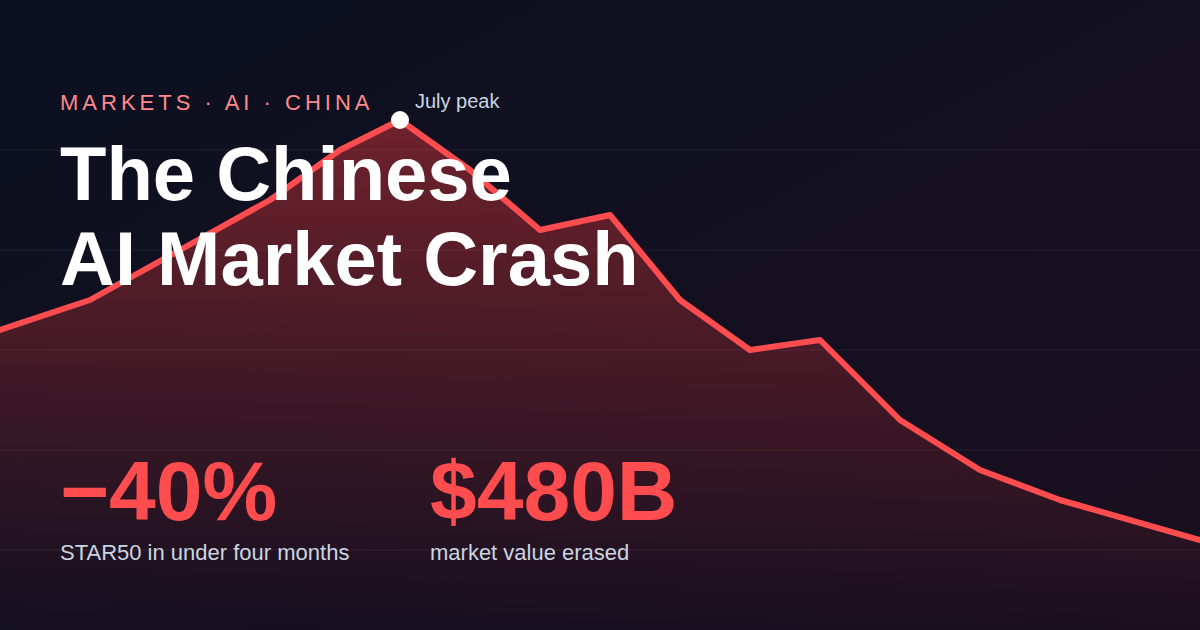
China’s AI boom has hit a wall. The STAR50, the Shanghai index packed with the country’s AI and chip leaders, has fallen about 40% in under four months. By Reuters’ tally, that is roughly $480 billion in market value gone. For two years, Chinese AI stocks were the market’s favourite story. Now the question is whether this is a healthy reset or the start of something bigger.
How big was the bubble?
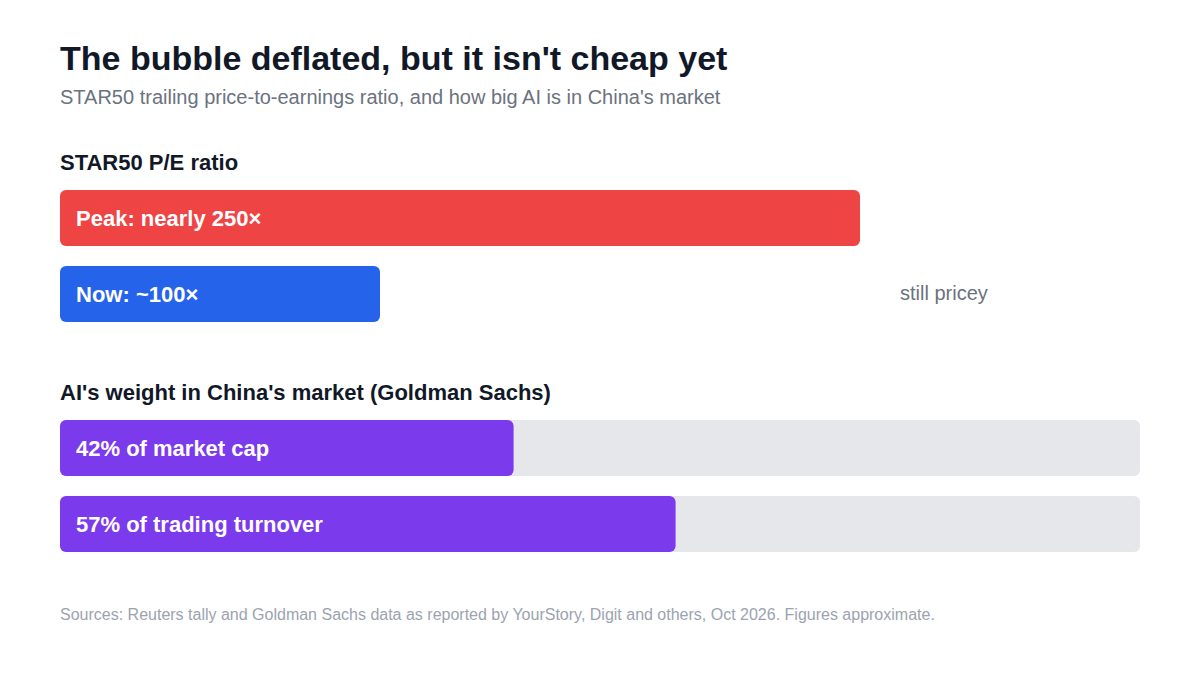
The scale of the exposure explains the damage. Goldman Sachs data shows AI stocks made up 42% of China’s market capitalisation and 57% of trading turnover across mainland A-shares and Hong Kong H-shares. When a single theme dominates a market that much, a slide in that theme becomes a market-wide event.
Valuations left little room for error. One analysis from early October put Zhipu at around 150 times annualized revenue and MiniMax at around 40 times. Warnings had come earlier too: in June, Wealspring Asset called the rally a “super bubble” and compared it to China’s 2015 frenzy.
What triggered the crash?
There was no single trigger. Several pressures landed together:
- Doubts about AI demand. Reports pointed to worries about AI demand and curbs on Chinese exports as lofty valuations unwound.
- Competitive shocks. In July, Moonshot AI open-sourced Kimi K3, with performance comparable to leading US models. That intensified fears of cheap, commoditised AI.
- US restrictions. Potential US limits on supplying Chinese products to American data centers added another risk.
- Price-war fears. One Shanghai fund manager argued that chipmakers and AI suppliers will eventually end up in a price war, like other Chinese manufacturers.
Retail investors took the hit
Individual investors were especially exposed. Reports note that retail investors had bet heavily on AI and chip stocks, and commentary linked the boom to efforts to steer household savers into equities to fund the AI build-out. When the sell-off came, the pain spread well beyond professional traders.
Is it cheap now?
Not necessarily. Even after the fall, the STAR50 trades at around 100 times trailing earnings, down from a peak of nearly 250. That is cooler, but it is not bargain territory.
Analysts disagree on what comes next. Goldman Sachs still lists Innolight and CXMT among its recommended Chinese AI stocks, and BNP Paribas strategist William Bratton has said the market offers buying opportunities. Others are more cautious. Bank of America’s Alex Liu said it is hard to say who will survive.
Does this hurt the rest of the world?
Global markets are nervous, but the link is unproven. The Nasdaq is about 6% below its record, a much milder drop, and no source shows China is dragging it down. Still, the episode is a reminder of how fast sentiment can turn when prices outrun earnings. US AI stocks have had a smaller pullback so far, but the same question hangs over them.
Does it end China’s AI ambitions?
Probably not. Analysts note that a $480 billion market collapse does not mark the end of China’s AI challenge to America. Stock prices and technological capability are different things, and Chinese labs still ship competitive models and make money. But Gavekal’s Leonid Mironov warns that a prolonged slump would make it very hard for China to reach its AI goals, since cheaper capital funds the chip and compute build-out.
Bottom line
China’s AI crash is both a cautionary tale and a reset. It shows what happens when a theme swells to dominate a market, when retail money piles in, and when valuations assume perfection. Whether it ends as a buying opportunity or a longer grind lower will depend on demand, export policy and whether profits catch up.
This post is for information only and is not financial advice. Market figures change quickly, so check current data before relying on them.
Sources
Want to discuss your own situation?
Talk to the VR Capittal team for a free consultation.
Chat on WhatsApp Contact Us