

AI Circular Financing Explained: The Hidden Risk Behind the AI Investment Boom
VR Capittal – Market Insights | 27 November 2026
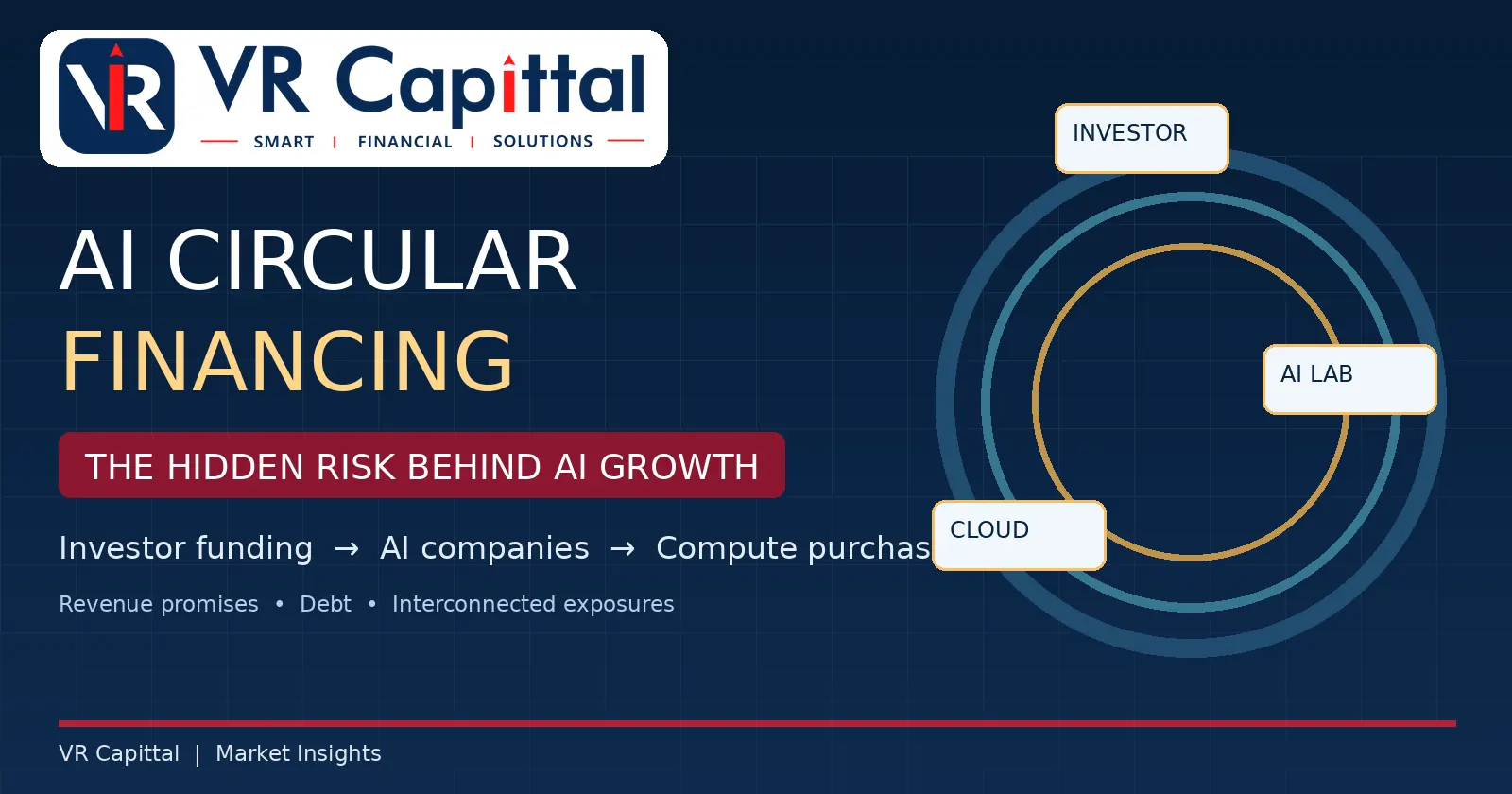
Billions of dollars are flowing into artificial intelligence. But the companies supplying AI chips, cloud computing and infrastructure are sometimes financing the customers buying their products. This is known as circular financing—and it is raising questions about the sustainability of the AI investment boom.
The concern is no longer limited to market commentators. The Bank of England, European Central Bank and International Monetary Fund have examined how interconnected funding, debt and future revenue promises could transmit financial stress.
What is circular financing in AI?
Imagine a chipmaker investing in an AI developer. The developer spends that capital on cloud computing. The cloud provider builds more data centres and orders more chips from the original supplier. The supplier now has both a financial stake in the ecosystem and product revenue linked to its expansion.
Illustrative example, not a claim about any specific transaction.
Such arrangements are not automatically unlawful or unsound. Strategic investment and vendor financing can accelerate development. The risk emerges when independent end-customer spending is insufficient to sustain the chain once investment flows or borrowing slow.
Why this matters now
In November 2026 the Bank of England cautioned that AI financing is becoming increasingly complex, circular and opaque, increasing the possibility that stress spreads from one area of the financial system to another. The IMF has separately analysed disclosed circular financing arrangements and warned that investment, lending and commercial commitments can reinforce each other.
Where circularity appears in real commercial relationships
Chipmakers and AI startups
Leading chip suppliers—including Nvidia—have invested in parts of the AI ecosystem that buy high-performance computing equipment. This alignment can support innovation and demand. Investors must nevertheless distinguish announced investment commitments from cash already deployed, and future equipment orders from recognised revenue.
Cloud platforms and AI developers
Major cloud providers may invest in AI developers while simultaneously selling them expensive compute capacity. A cloud provider’s reported revenue may therefore reflect purchases made using capital raised through strategic funding arrangements. Such revenue can be legitimate while still being sensitive to future fundraising conditions.
Data-centre operators and financiers
Operators may expand using debt, lease structures and multi-year capacity agreements based on expected AI demand. If utilisation disappoints, financing costs and fixed obligations remain. These commitments can spread losses to creditors, equipment suppliers and other counterparties.
Six financial threats investors should understand
1. Demand can look stronger than independent customer spending
Purchases financed through strategic investment may boost suppliers’ sales today without proving that outside customers will pay enough for AI services tomorrow. This creates sustainability risk—not proof that sales are fictitious.
2. One failure can spread across many firms
Stress at a major AI developer could affect the cloud platform receiving its payments, data-centre owners, chip suppliers, lenders and investors simultaneously.
3. Debt can amplify a slowdown
Interest, lease and repayment obligations do not disappear if growth disappoints. More private credit and structured financing can also make risks difficult to assess.
4. Valuations may reinforce each other
High valuations enable fundraising, which supports new infrastructure purchases. Suppliers report demand that can sustain their own valuations. If fundraising stalls, the feedback may reverse.
5. Infrastructure could be built ahead of profitable demand
Excess data-centre capacity, weaker utilisation or declining compute prices could impair returns even when AI adoption continues expanding.
6. The consequences can reach ordinary portfolios
AI-linked businesses carry significant weight in major equity indices. Credit markets and passive funds can therefore transmit a correction well beyond venture capital and specialist technology investors.
Does circular financing prove that AI is a bubble?
No. AI has genuine commercial applications. Strategic financing is a normal business tool, and significant infrastructure investment may generate long-term productivity gains. Neither the existence of circular arrangements nor a fall in AI share prices proves fraud or an inevitable collapse. However, transformative technology and excessive valuations can coexist.
Seven indicators every investor should track
| Indicator | What to investigate |
|---|---|
| Operating cash flow | Is cash generation keeping pace with reported revenue? |
| Customer concentration | Are sales dependent on a few funded AI developers? |
| Funding dependence | Could customers keep paying without fresh equity or borrowing? |
| Capital expenditure | Do expected returns support data-centre and chip spending? |
| Debt and leases | What fixed obligations exist, including less visible arrangements? |
| Actual AI monetisation | Are third-party customers paying sustainable prices and renewing? |
| Portfolio concentration | Do several holdings share exposure to the same AI funding cycle? |
Could the AI financing cycle create a wider financial crisis?
A serious correction might resemble aspects of the dot-com cycle: strong technological progress accompanied by investment expectations that run ahead of near-term commercial returns. But current market structures differ from earlier crises, and outcomes are uncertain. Large technology companies often have diversified businesses and profitable operations. At the same time, lending, private credit and concentrated equity holdings broaden potential contagion.
The question is not whether AI is transformative. It is how much sustainable cash flow the transformation can produce relative to the capital being committed today. Investors should examine financial dependencies, debt, valuation and genuine end-user demand—not treat every announcement of funding or compute spending as proof of long-term profitability.
Sources and further reading
- Bank of England, Financial Stability Report, November 2026
- IMF, The AI Ecosystem: Structure, Financing and Financial Stability Considerations
- ECB, The Debt Financing of AI and its Implications for Financial Stability
- Reuters, Bank of England on AI borrowing risks, 26 November 2026
Disclosure: This article provides general financial education, not a personalised investment recommendation or an allegation that any named company engaged in unlawful activity. Equity, debt and mutual fund investments involve risks. VR Capittal operates as a mutual fund distributor. Readers should assess their own risk profile and verify current regulatory and company disclosures.