

Collateral-free business loan: a 2026 guide for Surat MSMEs
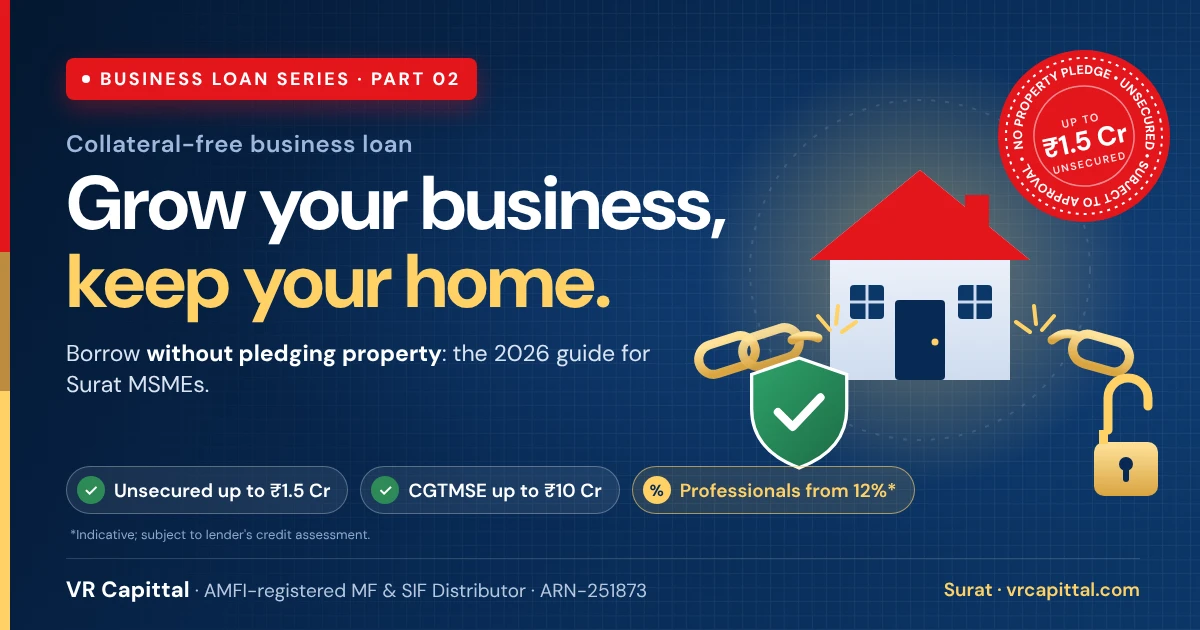
VR Capittal • Business Loan Series • Part 02
Ask any powerloom owner in Sachin, an embroidery unit in Varachha or a textile trader on Ring Road what stops them from borrowing, and you will often hear the same answer: “The bank wants my house as security.” A collateral-free business loan removes that condition, and the rules for it became noticeably more generous for small businesses in 2026.
In this guide, we explain what “collateral-free” really means, how much you can borrow unsecured (up to ₹1.5 crore through our lending partners, and up to ₹10 crore with the CGTMSE guarantee), the new RBI rule that protects small borrowers, what it costs, who it may and may not suit, and how a Surat business can apply.
A collateral-free business loan is one where you don’t pledge property or other assets as extra security. Depending on your profile, unsecured business loans can go up to ₹1.5 crore, and up to ₹10 crore when the lender covers the loan under the government-backed CGTMSE guarantee. Since 1 April 2026, banks also must not ask micro and small enterprises for any collateral on loans up to ₹20 lakh.
*Indicative. The actual rate depends on your profile, credit record and the lender’s assessment.
What is a collateral-free business loan?
Collateral is an asset you pledge in addition to the business itself, usually your home, shop, office or land. If you can’t repay, the lender can sell it to recover the money. A collateral-free loan doesn’t ask for that extra asset.
“Collateral-free” does not mean “no security at all”. The lender will usually still take a charge on what the loan pays for, such as the stock, receivables or machinery. This is called primary security. Many lenders also ask the owners for a personal guarantee. What you avoid is putting your family home or other property on the line.
Think of it like renting a flat when a respected elder in your community vouches for you, so the landlord doesn’t ask for a huge deposit. In business lending, that elder is the Credit Guarantee Fund Trust for Micro and Small Enterprises (CGTMSE), set up by the Ministry of MSME and the Small Industries Development Bank of India (SIDBI). It promises the lender that it will cover a large part of the loss if a covered loan goes bad.
Secured vs collateral-free: what changes for you
Collateral-free loan
- No property pledge
- Security: stock, receivables or machinery financed
- Faster paperwork (no property valuation or title search)
- May carry a guarantee fee and a slightly higher rate
Secured loan (e.g. against property)
- Home, shop or land pledged
- Often a lower rate and larger amount
- Valuation, legal checks and mortgage charges add time and cost
- The asset is at risk if repayments stop
What changed in 2026: the ₹20 lakh rule is a floor, not a ceiling
For years, RBI rules said banks must not take collateral for loans up to ₹10 lakh to micro and small enterprises (MSEs). Many websites still quote that figure. Through an amendment dated 9 February 2026, the RBI doubled the limit to ₹20 lakh for loans sanctioned or renewed on or after 1 April 2026.
The amendment also says:
- Banks may go up to ₹25 lakh without collateral for units with a good track record and financial position, as per their own policy.
- Units financed under the Prime Minister’s Employment Generation Programme (PMEGP) should also get collateral-free loans up to ₹20 lakh.
- If you voluntarily pledge gold or silver for a loan within this limit, the bank is not breaking the rule.
This rule applies to scheduled commercial banks lending to micro and small units. It sets the point below which a bank cannot ask for collateral. It does not cap how much you can borrow without collateral. Banks and Non-Banking Financial Companies (NBFCs) regularly lend well above ₹20 lakh unsecured, based on your turnover, profits and credit record.
How far a collateral-free business loan can go
The main routes, compared
| Route | Typical amount | Who lends | What to watch |
|---|---|---|---|
| RBI collateral-free rule | Up to ₹20 lakh (₹25 lakh at the bank’s discretion) | Scheduled commercial banks | Applies to micro and small units; the bank may still seek CGTMSE cover |
| CGTMSE-backed loan | Up to ₹10 crore | Banks, eligible NBFCs and other member lending institutions | Annual guarantee fee, often passed on to you; not every lender offers it for every product |
| Pradhan Mantri Mudra Yojana (PMMY) | Shishu up to ₹50,000; Kishore up to ₹5 lakh; Tarun up to ₹10 lakh; Tarun Plus up to ₹20 lakh | Banks, NBFCs, microfinance institutions | Non-corporate, non-farm micro units; Tarun Plus only after a Tarun loan is repaid |
| Unsecured business loan | Up to ₹1.5 crore, based on your profile | Banks and NBFCs | Quick and property-free; the rate depends on turnover, profits, vintage and credit score, so compare the Key Fact Statement |
| Unsecured loan for professionals | Varies with income and practice vintage | Banks and NBFCs | For doctors, chartered accountants and similar professionals, rates can start around 12% p.a. |
Unsecured loans for professionals
Doctors, chartered accountants, architects and other self-employed professionals in Surat often qualify on easier terms, because lenders look at steady professional income rather than stock or receivables. For a clinic upgrade, new equipment or office expansion, unsecured rates for strong profiles can start around 12% p.a. The final rate depends on your income, years in practice and credit score.
How CGTMSE works for collateral-free business loans
CGTMSE does not lend to you directly. Your bank or NBFC lends, registers the loan with CGTMSE and pays an annual fee. If the loan later turns bad, CGTMSE pays the lender a share of the defaulted amount, typically 75% to 90% depending on the borrower category. Cover is higher for micro units and women-owned units, for example.
Since 1 April 2025, the maximum loan that can be guaranteed is ₹10 crore (up from ₹5 crore). Manufacturing, services and trading units that qualify as micro or small enterprises can be covered.
If a ₹50 lakh covered loan to a small unit goes bad
✓For the lender
With standard 75% cover, CGTMSE bears most of the loss on the amount in default. This is why a lender can lend without asking for your property.
!For you
The guarantee protects the lender, not you. You still owe the full amount, your credit score is affected, and the lender can still recover dues.
What does the guarantee fee cost?
The Annual Guarantee Fee (AGF) was cut from 1 April 2025. It depends on the loan size and is charged on the loan amount in the first year and on the outstanding balance after that. Concessions apply for some borrower categories.
CGTMSE standard annual guarantee fee by loan size (% per year)
A quick example: on a ₹50 lakh loan, 0.55% works out to ₹27,500 in the first year. If the lender passes this to you, add it to the processing fee and interest when you compare offers. As we explained in Part 01: Business loan checklist, the Key Fact Statement (KFS) is the place to compare the total cost.
Who qualifies?
The ₹20 lakh rule and CGTMSE are both for micro and small enterprises. Since 1 April 2025, these are defined as:
| Category | Investment in plant, machinery or equipment | Annual turnover | Collateral-free rule & CGTMSE? |
|---|---|---|---|
| Micro | Up to ₹2.5 crore | Up to ₹10 crore | Yes |
| Small | Up to ₹25 crore | Up to ₹100 crore | Yes |
| Medium | Up to ₹125 crore | Up to ₹500 crore | No (other options apply) |
Many Surat weaving, embroidery, dyeing, jewellery and trading units are likely to fall in the micro or small band. To prove it, you need an Udyam Registration Certificate, which is free on the government’s Udyam portal. Banks use the category shown on it.
Lenders will also look at the same things we listed in Part 01: credit score, bank statements, GST returns, income tax returns and existing loans. See the documents list on our business loan page.
Remember: no collateral does not mean no consequence. If repayments stop, your credit score falls, the lender can still recover dues from the business and any personal guarantor, and future borrowing becomes harder. Also be wary of anyone who promises a “guaranteed CGTMSE loan” for an upfront fee. CGTMSE does not lend directly, only the lender decides, and fees should be paid only to the lender through official channels.
Who it may suit, and when to wait
May suit you if
- You run a micro or small unit with steady GST-filed sales
- You don’t own property, or don’t want to pledge your home
- You need working capital, stock or machinery, and the amount is modest compared with turnover
- Your bank statements show regular inflows
Consider waiting if
- Your EMI would only work in your best season
- Your credit report has recent delays or errors you haven’t fixed
- You need a large, long-term amount and have property, where a secured loan may cost less
- Your Udyam, GST or ITR records are incomplete
If a larger, longer loan makes more sense, compare it with a loan against property. For day-to-day funding, see working capital finance.
How to apply for a collateral-free loan in Surat
- Get your Udyam registration in order. Check that your category, activity and turnover details are up to date.
- Clean up your banking. Route sales through your current account so 6–12 months of statements reflect real turnover.
- Keep GST returns and ITRs filed on time. These are the main proof of income for an unsecured loan.
- Check your credit report and fix errors before applying, so you don’t need multiple applications.
- Prepare a short project note for a term loan: what you will buy, the cost and how it adds to revenue.
- Ask each lender directly whether the loan will be collateral-free under the RBI rule or CGTMSE, who pays the guarantee fee, and for its KFS.
Our four-step process shows how we support you from the first call to disbursal.
Need a business loan without pledging property?
Unsecured loans up to ₹1.5 crore, CGTMSE-backed loans up to ₹10 crore, and professional loans from around 12% p.a., subject to lender approval. VR Capittal compares offers across banks and lenders, helps prepare your file and supports you through to disbursal. We are an AMFI-registered Mutual Fund & SIF Distributor (ARN-251873) based in Surat, serving businesses across India.
Frequently asked questions
Can a bank in Surat ask for my house as security on a ₹15 lakh business loan?
If your unit is a micro or small enterprise and the loan is from a scheduled commercial bank, sanctioned or renewed on or after 1 April 2026, RBI rules say the bank should not take collateral for loans up to ₹20 lakh. NBFCs follow their own policies.
Is a CGTMSE loan the same as a government loan?
No. The bank or NBFC lends its own money. CGTMSE only guarantees part of the loan to the lender. You repay the lender in full, with interest.
Can textile and diamond traders get collateral-free loans?
Trading units that qualify as micro or small enterprises can be covered under CGTMSE, and retail and wholesale traders can register on the Udyam portal. Whether you are approved depends on your financials and the lender’s policy.
How much can I borrow without collateral?
It depends on your turnover, profits, banking and credit record. Through our partner banks and NBFCs, eligible businesses and professionals can raise unsecured loans of up to ₹1.5 crore. With CGTMSE cover, collateral-free loans can go up to ₹10 crore.
Will a collateral-free loan cost more than a loan against property?
Often, yes, because the lender has less security, and a guarantee fee may apply. Professionals with strong profiles can see unsecured rates starting around 12% p.a. Compare the annual cost in each lender’s KFS, not just the headline rate.
- Business loan checklist: 7 things to check before you apply
- Collateral-free business loan: a 2026 guide for Surat MSMEs (you are here)
- Working capital loan: cash credit vs overdraft explained (coming next)
- Loan against property vs unsecured business loan: how to choose
- How to improve your business loan eligibility
The bottom line
For micro and small businesses in Surat, a lack of property no longer has to block access to bank credit. Unsecured loans of up to ₹1.5 crore, CGTMSE cover up to ₹10 crore and the RBI’s ₹20 lakh no-collateral rule have widened collateral-free borrowing. But you still repay in full, so compare the total cost and borrow only what your weakest months can support.
Disclaimer: This article is for general information and education only and is not personalised financial, tax or legal advice, or an offer or promise of credit. Amounts and rates mentioned (including up to ₹1.5 crore and rates from around 12% p.a.) are indicative, not offers. Loan approval, amount, interest rate, charges and security requirements are decided solely by the lender based on its credit policy and your eligibility. Scheme rules (RBI, CGTMSE, PMMY) and figures are as of November 2026 and may change; please confirm details with the lender before applying. Loan products are not regulated by SEBI or AMFI. VR Capittal is an AMFI-registered Mutual Fund Distributor & SIF Distributor (ARN-251873) and is not a SEBI-registered Investment Adviser. Pay fees only to the lender through official channels and never share OTPs.
Sources
- RBI, Lending to MSME Sector (Amendment) Directions, 2026 (9 February 2026): rbi.org.in/scripts/FS_Notification.aspx?Id=13290
- RBI, Master Direction: Lending to MSME Sector (updated 9 February 2026): rbi.org.in/Scripts/BS_ViewMasDirections.aspx?id=11060
- RBI, FAQs on Micro, Small and Medium Enterprises (MSME classification, CGTMSE): rbi.org.in/scripts/FS_FAQs.aspx?Id=84
- RBI, Pre-payment Charges on Loans Directions, 2025 (2 July 2025): rbi.org.in/Scripts/NotificationUser.aspx?Id=12878
- RBI, Key Facts Statement (KFS) for Loans & Advances (15 April 2024): rbi.org.in/Scripts/NotificationUser.aspx?Id=12663
- CGTMSE, official website (guarantee ceiling, fee revision): cgtmse.in
- Office of the DC (MSME), Credit Guarantee Scheme guidelines: dcmsme.gov.in
- PIB, Pradhan Mantri Mudra Yojana: loan limit raised to ₹20 lakh (29 October 2024): pib.gov.in/PressReleasePage.aspx?PRID=2069170
Want to discuss your own situation?
Talk to the VR Capittal team for a free consultation.
Chat on WhatsApp Contact Us