

What Is a SIF? Specialised Investment Fund Explained for Beginners
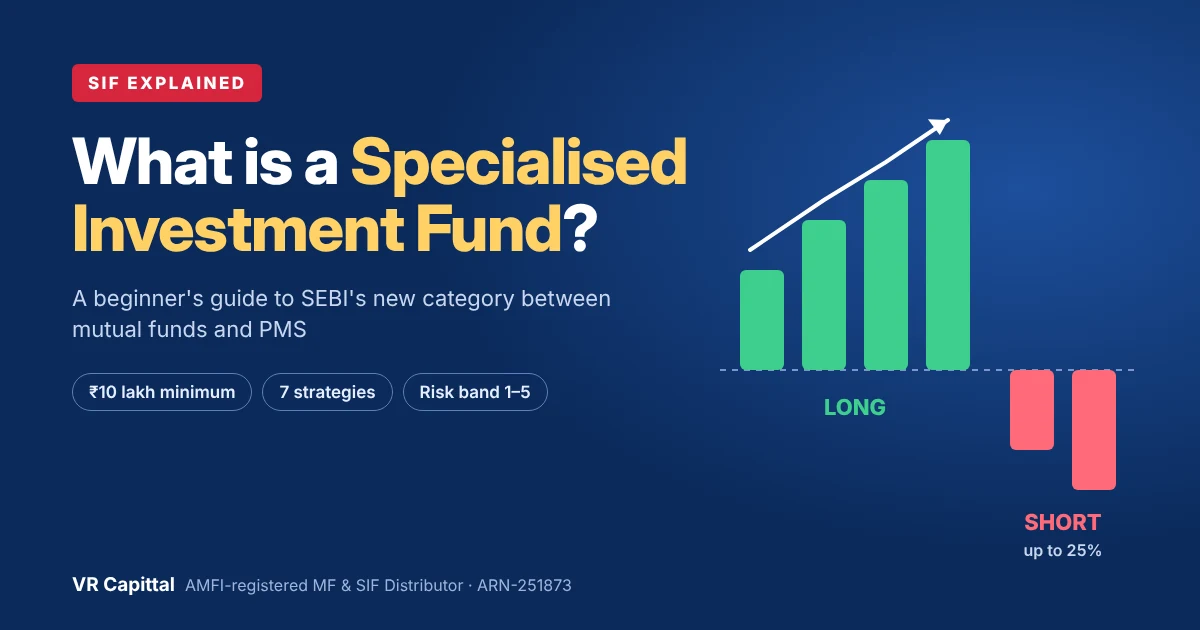
You may have heard the term SIF from your fund distributor, in business news or on social media. The Specialized Investment Fund is India’s newest investment category, and interest in it has grown fast since the first funds opened in late 2025.
This first part of our SIF series explains, in plain words, what a SIF is, why SEBI created it, how it works and who it may suit. No jargon without an explanation, and no sales pitch.
A Specialized Investment Fund (SIF) is a SEBI-regulated investment product, run by mutual fund companies (AMCs), that can use more flexible strategies than a regular mutual fund, including limited short positions, and needs a minimum investment of ₹10 lakh.
What does SIF stand for?
SIF stands for Specialized Investment Fund, the spelling SEBI uses. You will also see it written as Specialised Investment Fund. Both mean the same thing.
The SEBI framework came into force on 1 April 2025. A SIF is offered by an existing mutual fund AMC under a separate brand name, so you can tell it apart from that AMC’s regular schemes. For example, SBI Mutual Fund runs its SIF as Magnum SIF and Edelweiss as Altiva SIF.
Each product inside a SIF is called an investment strategy, much like a scheme inside a mutual fund. Its rules are set out in an ISID (Investment Strategy Information Document), the SIF version of a scheme information document.
Why did SEBI create SIFs?
Before SIFs, an investor who wanted something more flexible than a mutual fund had two main regulated choices: Portfolio Management Services (PMS), which need ₹50 lakh, or Alternative Investment Funds (AIFs), which usually need ₹1 crore. That left a wide gap between a few thousand rupees in a mutual fund and ₹50 lakh in a PMS.
SEBI created SIFs to fill it: a product with more freedom than a mutual fund, a lower entry point than PMS, and the investor protections of the mutual fund framework.
Where a SIF fits: minimum investment
How does a SIF work?
Like a mutual fund, a SIF pools money from many investors. A fund manager invests the pool according to the strategy’s rules, and you hold units whose value (NAV) is published every business day.
The difference is what the manager may do. A regular mutual fund mostly makes money only when what it owns rises in price. A SIF can also take short positions.
Long and short, explained simply
↑Long position
The fund buys a share or bond it expects to rise. Gains if the price goes up, loses if it falls. Every mutual fund does this.
↓Short position
Using derivatives, the fund takes a position that gains if a price falls, and loses if it rises.
SEBI caps unhedged short positions at 25% of a strategy’s net assets. “Unhedged” means the short is a real bet on a price falling, not just protection for something the fund already owns.
Think of a cricket captain who can both attack and defend. A regular mutual fund mostly attacks: it does well when markets rise. A long-short SIF can also set some defensive fields, so it may lose less in a falling market, or gain when particular stocks fall. But if the manager reads the game wrongly, those bets can lose money too.
The 7 types of SIF strategies
SEBI has defined seven strategy types. Each AMC can run at most one strategy of each type.
Liquidity is one of the biggest differences between strategies. An AMC can also set a notice period of up to 15 working days, and interval strategies can only be redeemed on set days. Check this in the ISID before investing. Our SIF strategy table covers each type in more detail, and Part 02 of this series explains them with examples.
The ₹10 lakh minimum, explained
- It is counted per PAN, per SIF. If one SIF offers three strategies, your total across all three must be at least ₹10 lakh. You do not need ₹10 lakh in each.
- Your regular mutual fund holdings do not count, even with the same AMC.
- For joint holdings, the first holder’s PAN is used.
- SIP, SWP and STP are allowed where the AMC offers them, as long as you stay above the minimum.
- Accredited investors (certified under SEBI’s income or net-worth criteria) are exempt.
What if your investment drops below ₹10 lakh? It depends on why:
Passive breach
The market (NAV) fell.
- Nothing is sold; you stay invested
- Only full redemption allowed while below
Active breach
You redeemed or transferred units.
- Units frozen; 30 days to top up
- Otherwise units are redeemed automatically
SIF vs mutual fund vs PMS: a quick comparison
| Mutual fund | SIF | PMS | |
|---|---|---|---|
| Minimum investment | A few hundred rupees (SIP) | ₹10 lakh | ₹50 lakh |
| Short positions | Generally only for hedging | Up to 25% unhedged | Depends on the strategy |
| Ownership | Units of a pooled scheme | Units of a pooled strategy | Securities in your own name |
| Risk label | Riskometer | Risk band, Level 1 to 5 | Strategy disclosures |
| Regulated under | SEBI mutual fund rules | SEBI mutual fund rules | SEBI portfolio manager rules |
For a fuller comparison that includes AIFs, see our SIF vs mutual fund, PMS and AIF table.
How big is the SIF market in India?
The category is small next to the ₹83 lakh crore mutual fund industry, but it has grown quickly. According to AMFI data, SIF assets were about ₹2,932 crore in November 2025 and about ₹42,670 crore by 31 October 2026, spread across 37 live strategies from 18 AMCs and about 1.76 lakh investor folios. Hybrid strategies hold the largest share, roughly 70% of SIF assets.
SIF industry assets (₹ crore, month-end)
Fast growth shows investor interest. It does not tell you whether any single strategy will do well, or whether it suits you. See the latest figures in our SIF market data section, and the official list of SIFs in AMFI’s SIF section.
Benefits and risks of SIFs
Possible benefits
- Access to long-short strategies that were earlier mostly available through PMS or AIFs
- A lower entry point than PMS (₹10 lakh vs ₹50 lakh)
- SEBI mutual fund rules apply: daily NAV, standard KYC, and holdings shown in your CAS
- Short positions may, in some markets, help cushion falls
Risks to understand
- Market risk: both long and short positions can lose money
- Manager risk: results depend heavily on the fund manager; returns are not guaranteed
- Liquidity risk: some strategies can’t be redeemed every day, and notice periods may apply
- Short history: the category is new, so there is little track record to judge by
- Costs and tax: expenses, exit loads and tax treatment differ by strategy
How are SIFs taxed?
SIFs are taxed under the same rules as mutual funds. The rate depends on how the strategy is classified (for example, equity-oriented or not) and how long you hold the units. Because SIFs use derivatives and can change their mix, check each strategy’s classification in its ISID, and confirm your own position with a tax professional.
Is a SIF right for you?
A SIF may be worth a conversation if:
- You can set aside at least ₹10 lakh for the long term
- You already have a core portfolio of mutual funds or other investments
- You understand that derivatives add risk as well as flexibility
- You are comfortable with returns that may look very different from the market
It is probably better to wait if you may need the money in the next few years, if you don’t yet have an emergency fund and insurance, or if ₹10 lakh would be most of your savings. For most first-time investors, mutual funds and SIPs are a better place to start.
How to invest in a SIF
Only AMFI-registered distributors who hold the SIF certification can distribute SIFs. The process is similar to a mutual fund:
- Check the fit with your goals, existing portfolio and liquidity needs
- Read the ISID: limits, risk band, redemption terms, exit load and costs
- Complete KYC (the same as for mutual funds) and invest at least ₹10 lakh
- Review regularly and keep an eye on the ₹10 lakh minimum
Wondering if a SIF fits your portfolio?
VR Capittal is an AMFI-registered Mutual Fund & SIF Distributor (ARN-251873) in Surat, serving investors across India.
Frequently asked questions
Is a SIF the same as a mutual fund?
No, but it is regulated under SEBI’s mutual fund rules. A SIF is run by a mutual fund AMC under a separate brand, needs ₹10 lakh to start and can use strategies, such as unhedged short positions of up to 25%, that regular mutual funds cannot.
Is a SIF safe?
A SIF is regulated by SEBI, but regulated does not mean risk-free. SIFs can lose money, and some strategies carry higher risk than regular mutual funds because they use derivatives and short positions. Check each strategy’s risk band and ISID.
Is SIF the same as SIP?
No. A SIP is a way of investing a fixed amount regularly. A SIF is a type of investment product. You can use a SIP to invest in a SIF, where the AMC offers it, as long as your total stays at or above ₹10 lakh.
Can NRIs invest in SIFs?
It depends on the AMC and the rules for the investor’s country of residence. Please check with your distributor before applying.
When did SIFs start in India?
SEBI’s SIF framework came into force on 1 April 2025, and the first SIF strategies opened to investors in late 2025.
- Part 02: SIF long-short strategies explained with examples
- Part 03: SIF vs mutual funds vs PMS vs AIF
- Part 04: Risks, redemption rules, costs and taxation
- Part 05: How to read a SIF’s ISID before investing
The bottom line
Specialized Investment Funds widen the choices open to Indian investors who can invest ₹10 lakh or more. Their main attraction is strategy flexibility, not any promise of better returns. Understanding how a strategy uses its tools, what it costs, when you can withdraw and how it can lose money is the starting point for an informed decision.
Disclaimer: Investments in Specialized Investment Funds are subject to market risks, including risks from the use of derivatives and short positions. Read all strategy-related documents (ISID) carefully before investing. Past performance is not indicative of future returns. This article is for general investor education only and is not personalised investment, tax or legal advice, or a recommendation of any SIF or strategy. Brand names are mentioned only as examples. VR Capittal is an AMFI-registered Mutual Fund Distributor & SIF Distributor (ARN-251873) and is not a SEBI-registered Investment Adviser. Data and rules as of November 2026; regulations may change.
Sources
Want to discuss your own situation?
Talk to the VR Capittal team for a free consultation.
Chat on WhatsApp Contact Us