

Should I Stop My SIP? What the Latest SIP Data Tells Investors (2026)
In October 2026, more SIPs ended than started across India’s mutual fund industry. Headlines about a rising “SIP stoppage ratio” have left many investors asking the same question: should I stop my SIP too?
This guide explains what the latest SIP numbers really show, what the stoppage ratio does and doesn’t mean, what stopping a SIP in a weak market can cost you, and when reviewing or stopping one genuinely makes sense.
Usually, no. A SIP is built for long periods that include flat and falling markets. Review it when your goal, your income or the fund’s role in your plan changes, not because of a few months of weak returns or a news headline.
What the latest SIP numbers show
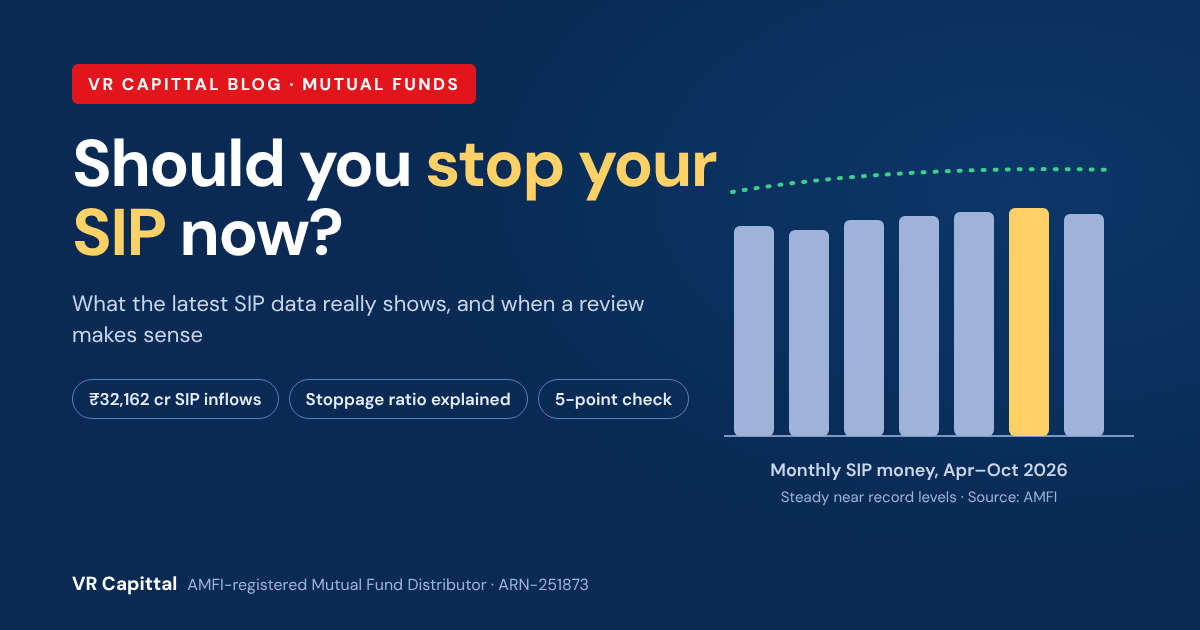
Two trends are running side by side. Fewer new SIP accounts are being added, but the money flowing in through SIPs has held steady near record levels.
- In the first half of FY27 (April to September 2026), net additions to SIP accounts were about 44.6 lakh, roughly half the 83.7 lakh added in the same period a year earlier.
- Over the same six months, monthly SIP contributions still rose from about ₹31,115 crore to a record ₹32,490 crore in September.
- In October 2026, about 59.1 lakh SIPs were discontinued or completed against 50.7 lakh new registrations, according to AMFI data reported by the media. Contributions dipped about 1% to ₹32,162 crore.
Monthly SIP contributions, 2026 (₹ crore)
| April–September | 2026 (H1 FY27) | 2025 (H1 FY26) |
|---|---|---|
| Net new SIP accounts | 44.64 lakh | 83.66 lakh |
| Total SIP accounts (end-September) | 10.89 crore | 9.73 crore |
| Growth in monthly SIP contributions over the half-year | 4.4% | 10.2% |
Why the slowdown? Analysts suggest that muted market returns since the correction that began in September 2024 may have played a part, but the data alone can’t say whether it is fewer new investors, more people stopping, or both.
What the “SIP stoppage ratio” really means
The stoppage ratio compares the number of SIPs that ended in a month with the number of new SIPs registered in that month. In October, 59.1 lakh ended and 50.7 lakh started, so the ratio was about 117%.
It’s easy to misread. A ratio above 100% does not mean that more than all investors stopped investing. Two very different things are counted together as “ended”:
Discontinued
The investor cancelled the SIP before its end date.
- This is the part that reflects investor behaviour
- Some are later restarted or moved to another fund
Tenure completed
The SIP reached the end date the investor chose.
- Planned and normal, like a recurring deposit maturing
- Many SIPs are set up with a fixed end date, often 3–5 years
So the ratio is a useful signal of industry mood, but it says nothing about whether your SIP is still right for you.
Why investors stop SIPs in flat or falling markets
Most SIP stoppages aren’t caused by a change in the investor’s goals. They come from feelings that are completely natural:
- “My SIP is showing a loss.” Recent instalments bought at higher prices look red after a fall, and it feels like money is being wasted.
- “An FD is giving more.” After a weak year, a fixed deposit looks better on paper, though it is a different product for a different purpose.
- “I’ll restart when markets recover.” This sounds sensible, but nobody can reliably tell when that will be.
- Headlines. Stories about rising stoppages can themselves make people nervous.
Think of a SIP like a long Test match rather than a T20. There will be slow sessions where runs dry up. Batters who walk off during a tough session can’t score when conditions improve.
What stopping a SIP in a weak market can cost you
A SIP invests a fixed amount every month. When prices are lower, the same amount buys more units; when prices are higher, it buys fewer. This is called rupee cost averaging, and it works only if you keep investing through the low phases.
Illustration: ₹10,000 a month for 4 months
| Month | NAV (₹) | Amount invested | Units bought |
|---|---|---|---|
| 1 | 100 | ₹10,000 | 100.00 |
| 2 (market falls) | 80 | ₹10,000 | 125.00 |
| 3 | 90 | ₹10,000 | 111.11 |
| 4 | 110 | ₹10,000 | 90.91 |
| Total | Average NAV ₹95 | ₹40,000 | 427.02 units · average cost ₹93.67 |
The biggest unit purchases happened in the weak months. An investor who stopped in month 2 and restarted in month 4 would have missed exactly those cheaper units. Stopping also breaks the habit, and many people who “pause for a while” never restart.
When reviewing or stopping a SIP does make sense
Good reasons to review
- Your goal is near (within 1–3 years) and you want to move gradually to safer options
- A genuine cash crunch, job loss or medical need
- Your goal or risk appetite has changed
- The fund’s mandate, category or role in your portfolio has changed
- Too many overlapping funds that need cleaning up
Weak reasons to stop
- A few months, or even a year, of poor returns
- News about other people stopping SIPs
- A tip that “markets will fall further”
- Comparing recent returns with an FD rate
- Waiting for the “right time” to restart
Before deciding about a specific fund, compare it with funds in the same category over a full market cycle, not only the last few months. See our mutual funds and SIP guide for how fund categories and goal-based investing work.
Better options than stopping completely
If money is tight or you’re unsure, you rarely have to choose between “carry on as before” and “stop everything”:
- Pause instead of cancelling. Many fund houses offer a SIP pause facility for a limited period. Terms vary by AMC, so check before you use it.
- Reduce the amount. A smaller SIP keeps the habit and the averaging going.
- Keep your emergency fund separate. Three to six months of expenses in a liquid, safe place means you don’t have to touch long-term SIPs in a crisis.
- Use a step-up later. When your income rises, increase your SIP each year. Try our step-up SIP calculator.
- Switch within your plan, after a review, rather than redeeming in a hurry.
Thinking of stopping or changing your SIP?
Let’s review it against your goals first. VR Capittal is an AMFI-registered Mutual Fund Distributor (ARN-251873) in Surat, serving investors across India.
Chat on WhatsApp Mutual funds & SIP guideA 5-question check before you stop your SIP
- Has my goal changed? If the goal and its date are the same, the original reason for the SIP still stands.
- How far away is the goal? For goals 5+ years away, short-term market moves matter less. For goals within 1–3 years, a gradual shift to safer options may be wiser than stopping abruptly.
- Is this about cash flow or about fear? A real cash need is a valid reason; fear of further falls usually isn’t.
- Is the fund still doing its job? Judge it against its category and benchmark over several years, not against last month’s headlines.
- What will I do with the money instead? If the answer is “wait and see”, that is market timing.
You can see how regular investing adds up over time with our SIP calculator. The results are illustrations based on the return rate you enter, not a forecast.
Frequently asked questions
Is there a penalty for stopping a SIP?
Fund houses do not charge a penalty for stopping a SIP. Your existing units stay invested. Exit loads apply only when you redeem units within the period set by the scheme, and ELSS units are locked in for three years from each instalment’s date.
What happens if I miss a SIP instalment?
That month’s instalment is simply not invested. Your bank may charge a fee for a failed auto-debit, and some fund houses cancel a SIP after several consecutive missed instalments. Check your AMC’s terms.
Does a stoppage ratio above 100% mean investors are leaving mutual funds?
Not necessarily. The ratio counts SIPs that were cancelled and SIPs that reached their planned end date. Total monthly SIP contributions have stayed above ₹32,000 crore, close to record levels.
Should I stop my SIP and invest a lump sum when markets fall further?
That depends on predicting both the fall and the recovery correctly, which is very hard to do consistently. A SIP removes the need to time the market. If you have extra money, you can discuss adding it in a planned way.
Can I restart a SIP after stopping it?
Yes. You can start a new SIP in the same or another fund at any time, subject to the scheme’s minimum amount. Your earlier units remain invested in the meantime.
The bottom line
The latest data shows fewer new SIP accounts and more SIPs ending, but SIP money is still flowing in near record levels. For your own plan, the question isn’t what others are doing or what the market did last quarter. It is whether your goal, timeline and needs have changed. If they haven’t, staying the course is usually the more disciplined choice; if they have, review your SIP rather than simply stopping it.
Disclaimer: Mutual fund investments are subject to market risks; read all scheme-related documents carefully. Past performance is not indicative of future returns. Rupee cost averaging does not assure a profit or protect against loss in declining markets. The illustration in this article uses hypothetical figures. This article is for general investor education only and is not personalised investment, tax or legal advice, or a recommendation of any scheme. VR Capittal is an AMFI-registered Mutual Fund Distributor (ARN-251873) and is not a SEBI-registered Investment Adviser. Data as of November 2026.
Sources
Want to discuss your own situation?
Talk to the VR Capittal team for a free consultation.
Chat on WhatsApp Contact Us