

Jensen Huang Reinstated as Nvidia CEO: Why AI Stocks Rallied and What Investors Should Watch
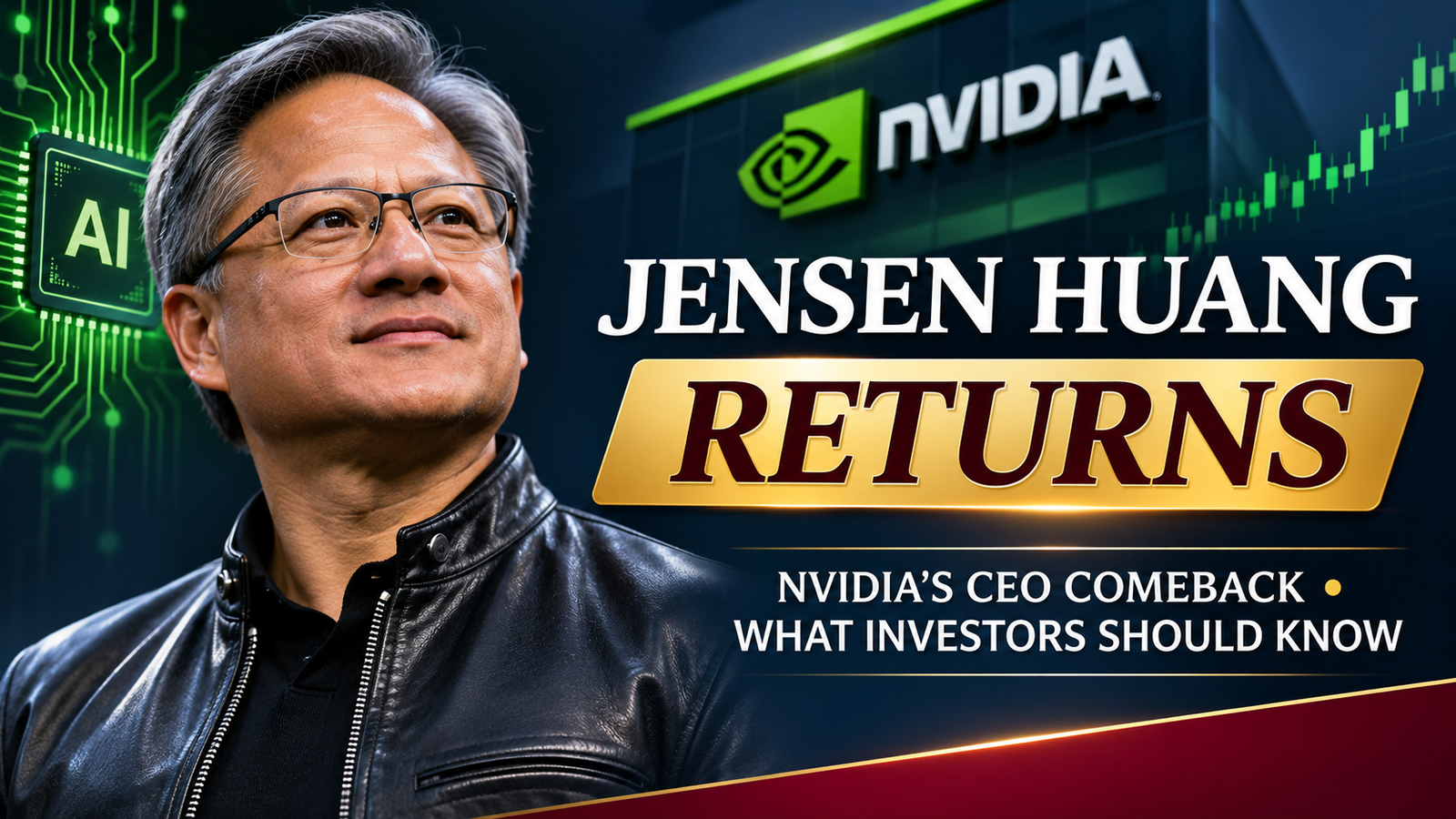
VR Capittal | Market Insights | 24 November 2026
Just 11 days after his departure, Jensen Huang is back at the helm of Nvidia. The chipmaker’s extraordinary leadership reversal has sparked a powerful recovery in AI-linked shares—but it has also reopened questions about governance, dependence on one executive, and regulatory scrutiny.
In our earlier article on Huang’s exit, we examined the leadership crisis and the market’s initial reaction. This follow-up looks at what changed, what Nvidia has actually confirmed, and what long-term investors should watch next.
Market movements are historical observations, not a forecast. Source: Nvidia and market reporting cited below.
What happened: Nvidia’s official announcement
Nvidia announced on 23 November 2026 that Jensen Huang had been reinstated as its President, Chief Executive Officer and board director, effective immediately. Its filing with the US Securities and Exchange Commission records the board action on 22 November 2026.
The board said it reached its decision after extensive discussions with Huang and receiving input from senior US government officials. Nvidia stated that it was confident his return did not present a national-security risk, and described the reinstatement as being in the interests of stockholders, employees, partners and customers. This is the company’s position—not a finding that every allegation or concern has been independently resolved.
Colette Kress, who had served as interim CEO while continuing as CFO, remains Nvidia’s Executive Vice President and Chief Financial Officer.
A remarkable reversal: the short timeline
| Date | Development |
|---|---|
| 12 Nov 2026 | Nvidia announces Huang’s resignation; Colette Kress becomes interim CEO. |
| Mid-November | Investors, employees and political figures debate Huang’s departure, while governance and national-security questions intensify. |
| 22 Nov 2026 | Nvidia’s board acts to reinstate Huang, as later recorded in its SEC filing. |
| 23 Nov 2026 | Nvidia publicly confirms his return; the company’s stock and the broader AI trade rally sharply. |
Why did the board change course?
Nvidia did not attribute its decision to a single factor. In its statement, the board emphasized leadership continuity, the company’s stakeholders, its discussions with Huang, and input received from senior US government officials. Reuters separately reported that US President Donald Trump urged Huang’s return and welcomed the decision.
Why did Nvidia and AI stocks rally?
Reuters reported that Nvidia shares jumped by roughly one-third on 23 November, helping lift AI-related companies and broader US stock-market sentiment. The reaction suggests investors placed considerable value on Huang’s continued leadership and the reduction of immediate succession uncertainty.
However, a rebound in share prices does not automatically prove that all earlier concerns have disappeared. A company’s long-term value still depends on the demand for its products, earnings growth, competitive position, cash generation, capital spending and its valuation relative to future expectations.
Is the controversy over?
No definitive conclusion should be drawn from the reinstatement alone. Huang’s earlier departure followed disclosures about personal relationships and allegations raising potential national-security concerns. Those allegations must remain clearly distinguished from established findings. Nvidia says it does not consider Huang’s return a security risk, but US lawmakers have called for further examination of the circumstances and government involvement.
For investors, the practical question is whether Nvidia can demonstrate a transparent governance process, credible oversight, clear succession planning, and consistent compliance with applicable export-control requirements.
Five things investors should monitor now
1. AI infrastructure demand
Track spending plans by cloud providers and AI companies, actual GPU shipments, order visibility and whether customer budgets continue to support Nvidia’s growth expectations.
2. Valuation versus earnings
A large one-day rally can reset market expectations quickly. Compare Nvidia’s share price with its earnings outlook, margins and growth assumptions rather than relying on headlines alone.
3. Export restrictions and geopolitical exposure
US–China semiconductor policy remains a significant factor. Regulatory approvals, restrictions and enforcement can affect Nvidia’s addressable markets and supply arrangements.
4. Corporate governance and succession
Investors should watch board disclosures, oversight arrangements and the depth of the senior leadership team. The episode demonstrates why succession planning matters even for exceptionally successful founders.
5. Spillover across the AI ecosystem
Semiconductor suppliers, data-centre companies and AI infrastructure businesses may respond strongly to Nvidia-specific news. Such co-movement does not mean their earnings prospects or risk profiles are identical.
Should investors buy Nvidia after the comeback?
| Investor situation | Consideration |
|---|---|
| Already holding a diversified allocation | Review the original investment thesis and current position size; a one-day jump alone need not dictate a decision. |
| Considering fresh exposure | Assess valuation, earnings sensitivity and portfolio concentration before investing; avoid assuming the rally guarantees further gains. |
| Highly concentrated in AI stocks | Evaluate correlation and downside risk across holdings, not merely the number of stocks owned. |
| Short-term or leveraged trader | Account for event-driven volatility, gap risk and the possibility of sharp reversals. |
Huang’s return removes a major near-term leadership uncertainty, but it does not eliminate valuation, governance or geopolitical risks. For disciplined investors, the key is to distinguish a headline-driven market rally from a durable improvement in business fundamentals.
Sources and further reading
- Nvidia investor relations: board reinstatement announcement (23 November 2026)
- Nvidia SEC Form 8-K: board action and executive leadership
- Reuters: reinstatement and AI market reaction (23 November 2026)
- Associated Press: congressional response (23 November 2026)
- Earlier VR Capittal coverage: Huang’s departure
Important: This article is for general financial education and market commentary only. It is not a recommendation to buy, hold or sell Nvidia securities, nor a statement that any unproven allegation is established fact. Equity investments involve risks, including substantial loss of capital. VR Capittal is a mutual fund distribution firm; readers should assess decisions based on their own circumstances and applicable regulations.